The Utility Bottleneck: Why Mega-Sites Stall on Power and Water (And How to Pivot)
The Executive Summary
When major industrial employers look at a region, momentum often stalls after initial interest. The issue is rarely land availability, environmental review, or zoning—it’s the Utility Bottleneck. By pivoting from speculative mega-projects to the "Mid-Scale Sweet Spot," cities can land immediate wins while building long-term infrastructure in parallel.
Across California, economic development agencies celebrate master plans as "shovel-ready" assets. In modern employment zones, target industries—advanced manufacturing, food processing, agri-tech, and logistics—are increasingly permitted by- right. Land use is no longer the hurdle.
So why are deals stalling?
Consider the data. Over a recent 18-month cycle, regional pipelines saw more than 10 major project RFIs representing $3.4 billion in capital investment and 3,400 projected jobs. Yet prospects routinely hesitate because utilities cannot commit to firm completion dates within tight 2-to-3-year market windows.
Mega-project prospects consistently demand:
● Electric Power: 10 to 40+ MW (scaling to 120 MW)
● Water & Wastewater: Up to 1.7 MGD
● Speed: Energization and hookups in 24 to 36 months
When a private manufacturer’s capital is tied to strict production schedules, an unconfirmed utility date is an automatic disqualifier. Municipalities don't lose projects to neighboring regions with cheaper land; they lose them because investor timelines outpace local utility schedules.
The Mid-Scale "Sweet Spot"
Holding out exclusively for a 100-acre mega-tenant ties up valuable land while waiting five to seven years for regional substations or treatment plants to catch up.
Instead, forward-looking jurisdictions target the Mid-Scale Sweet Spot:
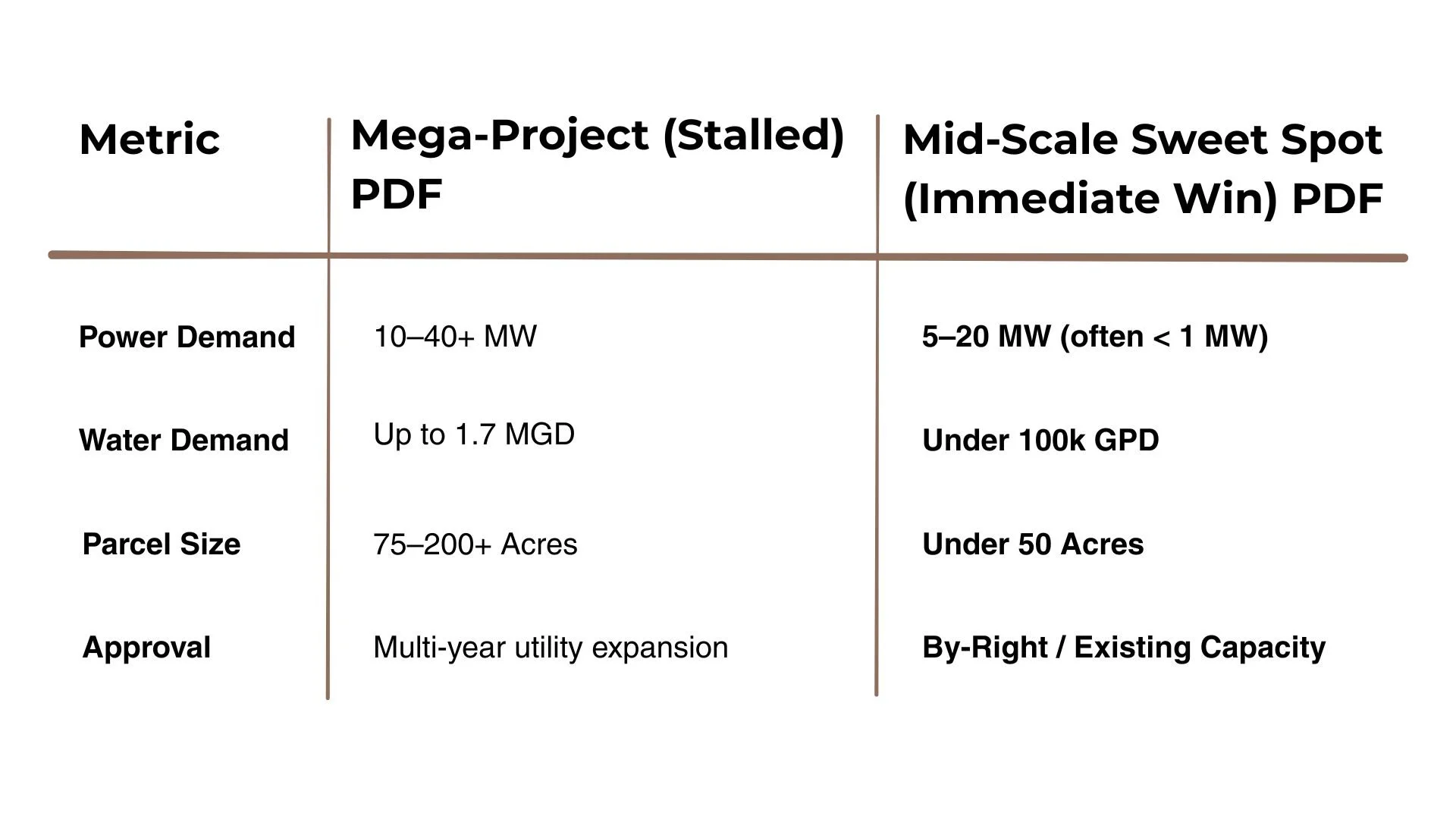
The Case in Point: A mid-scale food manufacturer represents an $80 million capital investment requiring just 0.3 MW of power. It fits within existing utility envelopes and operates by-right.
Landing one or two facilities of this scale accomplishes three vital goals:
1. Validates the Market: Demonstrates to the brokerage community that your agency can permit and deliver projects without delay.
2. Generates Near-Term Revenue: Activates immediate property tax, sales tax, and local jobs.
3. Funds Future Capacity: Provides the local revenue match needed to finance long-term backbone utility expansions.
The Bottom Line
In economic development, speed-to-market beats theoretical capacity. While your team pursues federal planning grants and coordinates with utility providers on regional expansions, prioritize sites under 50 acres that can connect today.
Stop selling vacant land. Start selling speed and certainty.