The Executive Summary
Part 1 examined why demand-driven economic development systems stall. This report focuses on the supply-side infrastructure that lets cities respond to investment interest with clarity, discipline, and certainty.
A Municipal Asset Library is a verified, investment-oriented database of publicly controlled sites, their development potential, and their known constraints. It is not merely an inventory; it is a decision and investment tool that helps cities determine which public properties are genuinely ready to advance.
Most cities can produce a spreadsheet of APNs, addresses, and departmental control. What they often lack is market intelligence: the zoning, utility, fiscal, and disposition information that allows staff to assess whether publicly controlled sites can move from municipal control to investment opportunity.
Publicly controlled sites should not be treated only as custodial liabilities. Used strategically, they can serve as public equity—helping de-risk workforce housing, activate commercial corridors, and attract target industries without relying solely on General Fund resources.
The 4 Pillars of a Municipal Asset Library
Transforming a property list into an investment-ready portfolio requires a disciplined audit of priority publicly controlled sites. Each pillar should answer three questions: what must be verified, why it matters, and what the city should produce.
1. The Entitlement & Regulatory Envelope
● Verify: Current zoning, general plan consistency, entitlement pathway, environmental status, and any threshold questions under the Surplus Land Act.
● Why it matters: Investors need to know whether the intended use is legally supportable, politically realistic, and procedurally clear before they spend time underwriting a site.
● Produce: A concise entitlement summary that identifies the allowable use, likely approvals, known constraints, and disposition considerations.
2. Ground-Level Utility Audits (At the Curb)
● Verify: Water, sewer, stormwater, electric, broadband, and transportation access at the parcel edge—not just somewhere nearby.
● Why it matters: Utility capacity is often the difference between a site that looks available and a site that can actually support investment within a reasonable timeframe.
● Produce: A utility readiness profile that documents available service, likely upgrades, responsible providers, and unresolved due-diligence questions.
3. Impact Fee & Capital Cost Scoping
● Verify: Development impact fees, utility connection charges, frontage improvements, off-site infrastructure needs, and potential fee credits or deferral options.
● Why it matters: Early cost visibility reduces underwriting uncertainty and helps staff distinguish between sites that are market-ready and sites that need public investment first.
● Produce: A preliminary cost and fee snapshot that investors can use to evaluate feasibility before entering negotiations.
4. Disposition Options
● Verify: Whether the city is better served by sale, lease, license, joint development, phased disposition, or another approach that protects public objectives.
● Why it matters: The right disposition path shapes revenue, control, affordability, timing, and long-term public benefit.
● Produce: A recommended disposition framework that identifies the preferred path, decision points, and issues to carry into solicitation or negotiation.
The Tactical Payoff
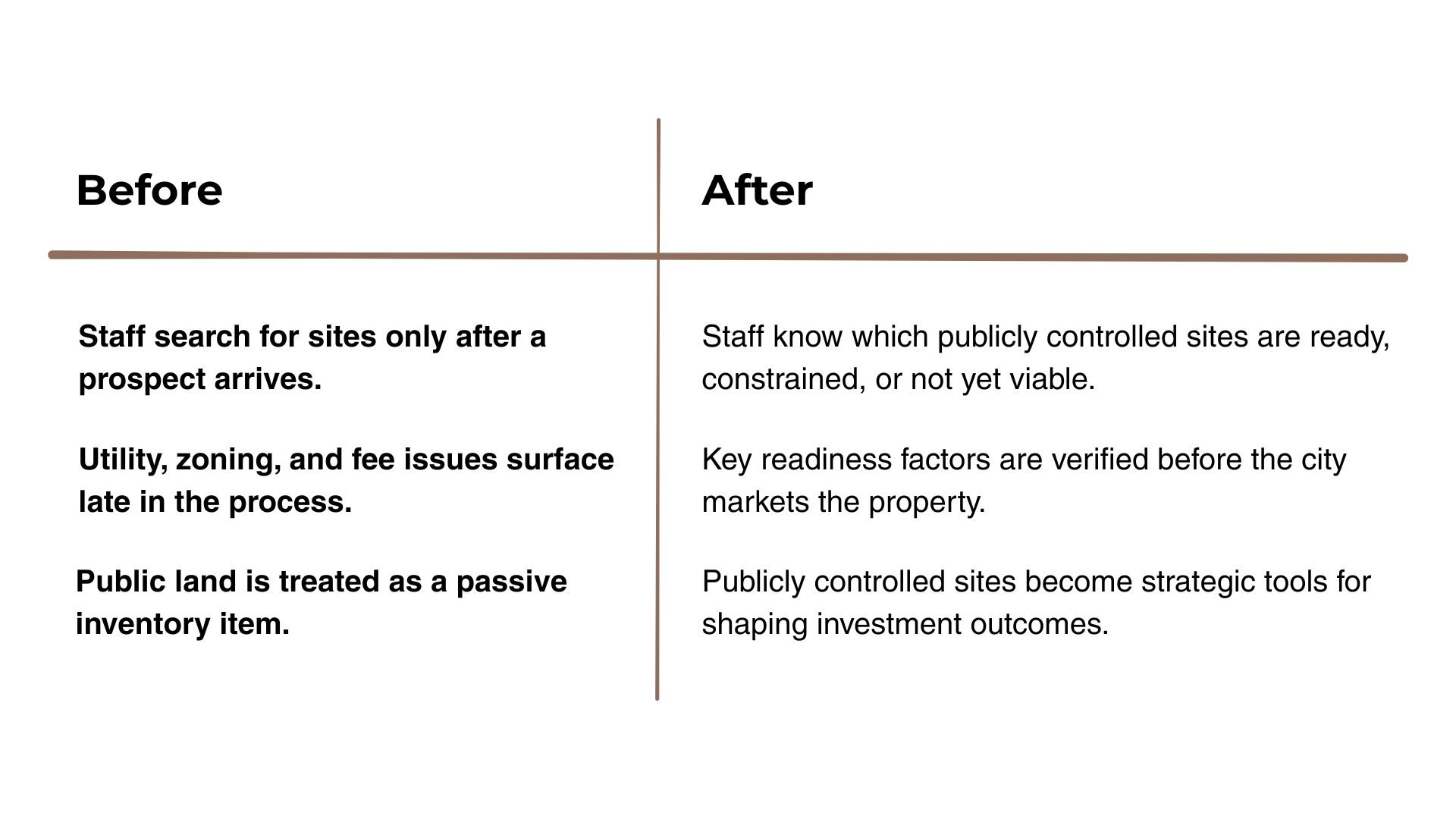
The value of a Municipal Asset Library is operational. It gives elected leaders, executive staff, and economic development teams a common basis for deciding which sites to advance, which sites need investment, and which sites should not be marketed yet.
The Bottom Line
Publicly controlled sites are more than real estate on a ledger—they are policy leverage. By verifying zoning, utility capacity, impact fees, and disposition options, local governments can move from reactive prospect-chasing to disciplined site readiness. Once priority sites are verified as genuinely ready to advance, the next challenge is converting readiness into a marketable opportunity and a workable transaction.